What the Earth Remembers: A Slow Journey Through the Mounds in Ohio
Discovering the Native American Mounds in Ohio
Two thousand years ago, people built monuments here that still stop you cold. Come ready to wonder.
There's a moment, somewhere on the grounds at Mound City, when it hits you. You've been walking across the grass, looking at the low green hillocks rising from the earth around you, and then something shifts — the scale registers, the age registers, the sheer intention behind it all registers — and you stop walking. You just stand there. You look out at the mounds and you think: someone built this.
People, with their hands and their backs and their baskets full of dirt, shaped this ground into something that has outlasted everything they ever knew. No written language survives to explain it. No records, no names, no note left behind. Just the earth, shaped with purpose, still here.
That's what it feels like to spend a day in the mound country around Chillicothe. It's not like any other kind of history. It doesn't come with explanations so much as it comes with questions — big, quiet ones that follow you home and sit with you for days.
Mound City: Where the Dead Were Honored
Start here. The visitor center at Mound City is the front door to the whole experience — a small museum with a good film and enough artifacts to give you a sense of who the Hopewell people were before you walk out among the mounds. Take your time with it. The things in the cases — copper cutouts shaped like eagle claws, pipes carved in the likeness of bears and otters, sheets of mica cut into human hands — are extraordinary, and they'll change the way you see what's outside.
The Hopewell culture flowered here in the Scioto River Valley from roughly 100 BC to 500 AD, a span of time almost twice as long as the United States has existed. They weren't a single tribe or nation so much as a shared spiritual vision — a way of building and burying and trading and honoring the dead that spread from here across half a continent.
At its height, their trade network pulled in copper from Lake Superior, obsidian from the mountains near Yellowstone, shark teeth from the Gulf Coast, and thin, shimmering sheets of mica from the mountains of the Carolinas. In a single mound, archaeologists have found materials from a dozen different places, thousands of miles apart. These were not isolated people in a quiet corner of Ohio. They were connected to a world.
And Mound City was, above all, a place to honor the dead.
Step through the gap in the earthen wall that surrounds the site — low and grassy now, only a few feet tall, but once much higher — and you're inside a 13-acre enclosure holding two dozen mounds. Each mound, when excavated, was found to cover the remains of a timber-framed building where the Hopewell prepared their dead for burial, most through cremation. Inside these buildings, they burned offerings: the copper, the mica, the obsidian. Things of great beauty and value, made and then given back. The ash from a thousand ceremonies is still in the ground beneath your feet.
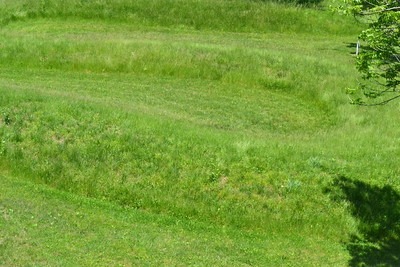
Walk slowly around the mounds. Don't rush from one to the next. Pick one and sit near it for a few minutes. The grass on the mounds is very green, and they have a rounded, gentle shape, like the backs of sleeping animals. They don't feel threatening. They feel cared for. That's probably the right instinct — this was a place of great tenderness, a place people came to grieve and to celebrate and to send someone they loved on their way.
Hopewell Mound Group: The Heart of It All
A few miles west of Chillicothe, on a quiet road through farmland, the site that gave the whole culture its name sits mostly unmarked, its earthworks reduced to barely-there swellings in the fields. The Hopewell family farmed this land in the 1890s when archaeologists first excavated it, and the name they carried became the name of an entire civilization. There's an accidental poetry in that.
What was here, in its time, was astonishing. More than 127 acres enclosed by three miles of earthen walls. At least forty mounds inside. A central mound rising thirty feet from the valley floor. The entire complex laid out with a geometric precision that still puzzles researchers — squares and circles that align with the movement of the moon in patterns so exact they could only have been intentional. The Hopewell were watching the sky the same way they were working the earth: carefully, systematically, over generations.
When the site was excavated in the 1890s, it held the greatest single collection of Hopewell artifacts ever found in one place. Those objects — the copper, the mica, the carved pipes — were packed up and taken to the 1893 World's Columbian Exposition in Chicago, and they're in the Field Museum there today. The land is quiet now, and there's a hiking trail along the northern rim of the earthworks. Walk it anyway. The scale of what's missing is still present. You can feel where the walls were. You can stand at what was the entrance and look out across the valley the way they would have looked, and the Scioto River still runs where it always ran, and the hills beyond are still the same hills.
Some places ask you to imagine. This is one of them.
Hopeton Earthworks and High Bank Works: Where the Earth Meets the Sky
These two sites — both part of Hopewell Culture National Historical Park — don't look like much when you first arrive. Hopeton is mostly fields. High Bank, across the Scioto from Mound City, has been reduced to suggestions of its original shape. But the research done here over the past several decades has revealed something that changes the way you look at the whole landscape.
The Hopewell aligned their earthworks to the moon.
Not just vaguely, not just roughly — precisely, to the 18.6-year cycle of the moon's rising and setting points. The great circle and octagon at Newark, the circle at Hopeton, the circle at High Bank — they're all keyed to the same lunar cycle, a pattern so consistent that it couldn't have happened by accident. To build these alignments, the Hopewell would have had to observe the moon across multiple generations, pass that knowledge down carefully, and then translate it into earthworks on a scale that required thousands of people working together.
Stand in the middle of these open fields and look up at the sky. The Hopewell stood in this same spot and watched the moon rise and set over years and years, and they built their world around what they saw. The earthworks are gone, mostly, but the sky is the same sky. On a clear night, the moon still rises exactly where they said it would.
Seip Earthworks: The Mound That Survived
Of all the Hopewell sites near Chillicothe, Seip gives you the most immediate physical sense of the scale these builders were working at. The main mound here — a long, low shape rising from the open fields of the Paint Valley — is one of the largest in Ohio that's still clearly visible, rising about thirty feet and stretching more than 250 feet in length. Farmers flattened most of the surrounding earthworks over the generations, but this central mound endured. It's still here, green and quiet, in a setting of extraordinary beauty.
The Paint Valley is the kind of Ohio landscape that makes you understand why people have stayed in this place for thousands of years. The hills are soft and wooded, the creek runs clean through the bottom of the valley, and the light in late afternoon goes long and golden across the fields. The Hopewell chose their locations deliberately — near water, open to the sky, sheltered by hills. They knew how to read a valley.
Walk out to the mound and stand next to it. Look back toward the treeline. The Hopewell gathered here — traveled here, sometimes from great distances, to participate in ceremonies they considered sacred. Archaeologists believe these earthwork complexes were not towns or villages; the Hopewell actually lived in small settlements scattered across the landscape. The earthworks were ceremonial centers, built and tended for specific purposes, places you came to for important occasions. Coming here was itself the point.
You are, in that sense, doing exactly what they did. You drove here. You walked out to the mound. You came to be present at something larger than daily life. Two thousand years of the same human impulse.
Serpent Mound: The Greatest Mystery of All
About an hour southeast of Chillicothe, on a narrow plateau above a winding creek valley in Adams County, sits the strangest and most beautiful earthwork in North America. Serpent Mound is 1,348 feet long — a quarter mile — and shaped like a snake uncoiling across the ridge. Its seven curves wind back along the body and its tail coils into a tight spiral. At the head, the mouth is open wide, apparently swallowing a great oval form — an egg, perhaps, or the sun.
Nobody knows who built it, exactly, or why. The leading research suggests it was first constructed around 300 BC, possibly by the Adena culture, and later renovated or rebuilt by the Fort Ancient people around 1070 AD — making it a site that two different cultures, a thousand years apart, both considered important enough to maintain. The plateau itself sits atop an ancient meteor impact crater, a geological feature so unusual that the land here has a different shape than the surrounding hills, and many researchers believe the builders chose this spot because the ground itself felt strange and powerful.
There is no burial here, no enclosure, no obvious function that archaeology can pin down. Just the snake, stretched across the ridgeline, open to the sky.
The best way to see the whole shape is from the viewing platform at the head — climb it and turn and look back along the body of the serpent, seven curves winding away from you through the trees. The mound is only a few feet tall, and from the ground you can't really take in its form. But from the platform, it opens up, and the shape becomes undeniable and strange and somehow moving. A quarter mile of earth, shaped like something alive. Made by hand.
Some researchers think the curves of the body align with the summer solstice sunrise, the equinoxes, the winter solstice. Whether or not those alignments are precise, the people who built this were watching the same sun we watch, marking the same turning points of the year we feel even now — the longest day, the shortest day, the moments when the seasons change.
What they were saying with this great serpent in the earth, we can only guess. But the saying of it was so important to them that they moved thousands of cubic feet of dirt to say it, and shaped it with enough care that it's still here, still recognizable, still legible as a serpent, more than two thousand years later.
Stand at the tail and look toward the head. Be quiet for a minute. Let the place be what it is.
A Note on Visiting the Mounds
Most of the earthwork sites around Chillicothe are free and open from sunrise to sunset. The visitor center at Mound City is your best first stop — the rangers there are genuinely passionate about this history and happy to answer questions. Allow yourself at least two days if you want to see everything without rushing, and plan for more time than you think you need at each stop, because these are places that reward standing still.
The mounds are not dramatic in the way of the Grand Canyon or Niagara Falls. They are low and green and quiet. Their power is cumulative, and it comes slowly. The more you know about who built them and what it took — the generations of observation, the thousands of workers, the materials brought from the Rocky Mountains and the Gulf of Mexico, all gathered here in the Scioto Valley — the more extraordinary they become. Give them time.
And when you're standing in one of these fields, looking at a mound or the ghost of a great earthen wall, let yourself feel the full weight of it. Two thousand years ago, people stood on this same ground and thought about the sky, and the dead, and what to build in honor of both. They had no machinery, no written plans, no guarantee that what they built would last. They did it anyway, with everything they had.
It lasted.
Come see.