Where the Stone Remembers: A Slow Journey Through the Hocking Hills Highlights
Why people return again and again to the Hocking Hills
Ohio's ancient sandstone hollows have kept their secrets for ten thousand years. They will share them — but only with those who are willing to linger.
There is a quality of light in the Hocking Hills that you won't find anywhere else. It comes down through the hemlocks and beeches in long, soft shafts, broken up by the sandstone ledges until it feels almost liquid — like light you could cup in your hands. It pools on the forest floor in slow gold coins and moves the way water moves. And if you stand still long enough inside it — not walking, not photographing, just standing — you start to understand why people have been coming to this corner of southeastern Ohio for more than ten thousand years. They kept coming back, generation after generation, as if the land itself were calling them home.
The Hocking Hills is not a place you drive through. It is a place you descend into.
Old Man's Cave: The Mouth of the World
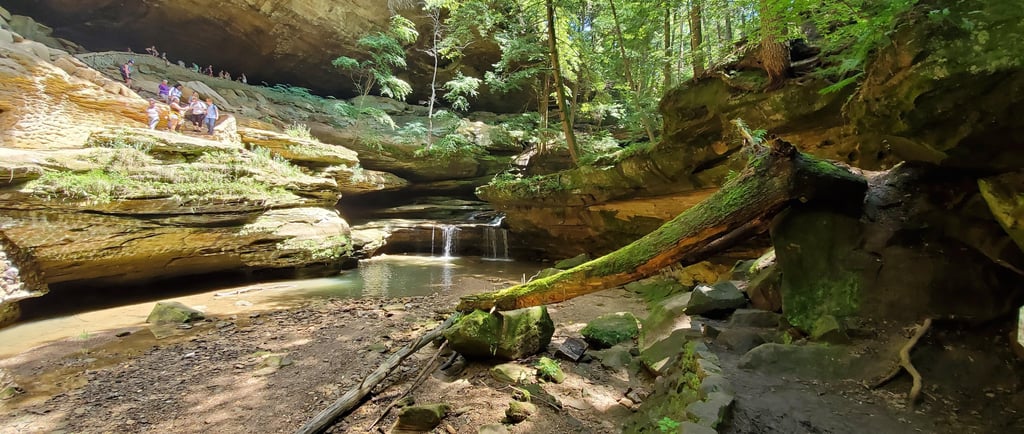
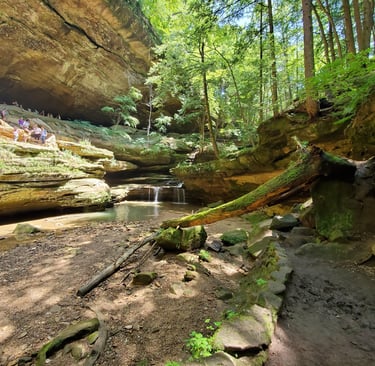
The trail drops from the parking lot and within a hundred yards you've left the twenty-first century behind. The cave opens before you like a held breath — a vast curved hollow in the sandstone, 200 feet wide and 75 feet high, the ceiling dark orange and dripping with water. The gorge below is narrow and green and cool, even in the deep heat of August. Hemlocks grip the rim. The creek runs dark over flat rock.
This is the place the Adena people knew. They were here before the Hopewell, before the Erie and the Shawnee who came after — a mound-building culture that understood these hills as sacred ground, a threshold between the everyday world and something much older. They left little behind in the caves themselves, but their presence lingers the way a dream lingers: not in any specific detail, but in the feeling of being watched by something patient and kind.
The cave takes its name from Richard Rowe, a frontier hermit who settled in the gorge in the early 1800s and lived out his final years beneath the overhang. He is buried here. His grave is marked with a simple stone, and the local children called him Old Man, and the name stuck — to the cave, to the gorge, to the whole trail system that winds six miles through the surrounding hollows.
But stay here a while, past the easy first look. Sit on one of the flat boulders and watch how the light shifts when clouds pass overhead. Notice how the temperature drops five, ten degrees as you move deeper under the rock.
The Adena noticed that. The Shawnee noticed it. The early settlers who scratched their names into the soft stone noticed it too, and those names — faint now, nearly swallowed back into the rock — feel like a kind of prayer. A very human insistence on I was here. I stood in this cool shadow. I felt exactly what you're feeling right now.
Walk slowly. The lower gorge trail winds past the Upper Falls and Lower Falls, through the Narrows where the walls press close enough to touch with both hands. Go ahead and touch them. The sandstone is 350 million years old, laid down when Ohio was a warm, shallow sea. What you're touching is ancient ocean floor, shaped by ten thousand years of water and ice into something almost impossible. Embrace that before you move on.
Cedar Falls: Sound Before Sight
You hear Cedar Falls before you see it. That matters. In a world that's always grabbing at your eyes, there's something deeply settling about following your ears through the woods — down the winding trail from the parking area, through a forest that gets thicker and darker as the gorge deepens — toward a sound that starts as a whisper and builds into a full, steady roar.
Cedar Falls is the largest waterfall in the Hocking Hills, dropping nearly fifty feet over a broad sandstone lip into a pool so clear it reads as green. Despite the name, it's hemlock trees that crowd the rim, their feathery branches trailing in the spray. The mix-up happened early, back in the pioneer years, and it stuck — a small reminder that people have always been making meaning in these hills, sometimes getting it exactly right, sometimes not, but always trying.
The Shawnee called this part of Ohio home for generations before European settlers arrived. Their trails followed the creek valleys — paths that worked with the land instead of cutting through it — and the Hocking Hills weren't just terrain to cross. They were a living map of stories. Waterfalls marked boundaries. Caves were shelters. Certain trees were gathering places. The whole landscape was a language, and they knew how to read it.
Stand at the base of the falls and let the mist find you. Feel the way the air here lifts something in your chest. You don't need a scientific explanation to know it's real — your body already knows. The Shawnee didn't need one either. They knew it the same way you know it now: in the breath, in the loosening of something you didn't even realize was tight.
Stay longer than feels comfortable. The falls have a rhythm that takes a few minutes to really settle into. Some people stop here for five minutes, take their pictures, and head back to the car. Others sit on the rocks for an hour and walk out looking different than when they came in. Try to be the second kind of person.
Ash Cave: The Great Gathering Place
If Old Man's Cave is a mouth and Cedar Falls is a voice, then Ash Cave is a council chamber.
It's the largest recess cave in Ohio — 700 feet across, 100 feet deep, with a ceiling that curves 90 feet overhead — and it has the unmistakable feeling of a place made to hold people, to carry their voices, to make them feel both small and safe at the same time. A seasonal waterfall drops from the cave's lip in a thin silver thread, landing in a mossy hollow below. Say something out loud in here and listen: your words come back to you softened and multiplied, like an echo heard in a dream.
The cave gets its name from an enormous pile of ash that European settlers found here in the mid-1800s — decades, maybe centuries, of campfire remains, left by waves of people who came here to shelter, to eat, to sleep, to talk. The Adena used this cave. The Hopewell used it. The Shawnee used it. And before all of them, the first people to move through the Hocking Valley after the glaciers pulled back, following game through a world that was just waking up.
Ten thousand years of fires. Sit with that for a moment.
The paved trail into Ash Cave is short and nearly flat — easier to reach than most places in the park — but don't let that fool you into rushing. Come early, before the crowds find their footing. Come in April or October, when the visitors thin out and the light comes in low and golden. In October, the maples above the cave rim turn the whole hollow amber, and the cave seems to glow from inside, as if it's remembering all those old fires.
Find a dry spot at the back of the cave and put your back against the sandstone. The wall is cool and dry even in the middle of summer. Close your eyes and just listen: the waterfall, the birds up on the rim, the wind in the hemlocks, the soft voices of other visitors smoothed out by the rock overhead. This is what it sounded like ten thousand years ago. This is what it sounded like last century. This is what it sounds like right now. In Ash Cave, time doesn't really pass. It just layers.
Rock House: Inside the Living Stone
Most of the caves in the Hocking Hills are really overhangs — big scoops in the cliff face, open to the air on one side. Rock House is different. It's a true cave, a tunnel bored clean through a sandstone cliff, 150 feet long and 25 feet high, with seven arched windows looking out over the gorge below. Walking through it feels like walking through a cathedral somebody forgot to finish.
Inside, the light comes through those windows in long, slanted beams. The walls are deep red and orange and black, carved into hollows and alcoves by centuries of wind and water. The temperature holds around fifty degrees no matter the season. The air smells like cold stone and something older than memory.
The Wyandot people used this place as a refuge. It made sense — one way in, commanding views from those stone windows, solid rock on all sides. Put your hand on the window ledge and look out at the green gorge below. You are seeing exactly what the Wyandot saw. The gorge hasn't changed. The hemlocks are the same hemlocks, or the children of the same hemlocks. The creek is the same creek. Only you are different — and maybe, standing here, not as different as you thought.
The alcoves along the walls are covered in carved names and initials, some going back to the early 1800s. Layer on top of layer, two centuries of visitors leaving their mark. We don't encourage adding to them — but it's hard to look at all those names without feeling something tender about them. Every single person who carved their initials into this rock was doing the same thing: reaching out to touch something ancient and saying I was here too. That urge is as old as we are. It's why the first humans pressed their hands against cave walls and blew colored dust around them. It's why you might feel the urge right now to press your own palm flat against the cool stone.
Go ahead. No one will mind.
Conkle's Hollow: The Narrowest Sky
At Conkle's Hollow, the walls rise 200 feet on either side and the gorge floor narrows down until the sky above you is just a thin ribbon of blue between the hemlock tops. Walking up through it, following the creek, you feel something that's rare in flat Ohio — real enclosure, real depth, the sensation of being held inside the earth instead of just passing over it.
The hollow is named for W.J. Conkle, who carved his initials into the sandstone in 1797. The date is still there, still legible. But the hollow was ancient when Conkle arrived, already wearing the shapes it has now — the walls laced with ferns and moss, the cold little trickles that feed the creek even in dry spells, the overhangs where the rock stays bone dry no matter how hard it rains outside.
There are two trails here. Take the gorge trail going in, and take it slow. Let your eyes settle into the shade. Down here the wind can't reach, and the quiet is its own kind of sound. Ferns crowd the path. The creek braids through the rocks. In May, wildflowers — trillium, wild ginger, hepatica — bloom quickly in the narrow light before the canopy closes over for summer, and the whole floor of the hollow seems to be holding its breath.
The rim trail back runs along the top of the gorge in open sun, with views straight down into the green slot below. Up here you'll find old gnarled pine trees twisted by wind into shapes that look almost deliberate — like something between sculpture and prayer. The contrast between down there and up here, between cool shadow and open sky, is part of what makes Conkle's Hollow feel whole — a place that holds both things at once.
Linger in the gorge on the way in. The rim will take care of itself on the way out.
Rose Lake Trail: The Quiet One
Not every sacred place makes a dramatic entrance.
Rose Lake sits tucked into the hills east of the main park corridor, quieter and less visited than the famous caves, circled by a gentle loop trail through tall, mature woods. There are no waterfalls here, no soaring stone walls. The trail is soft underfoot with years of fallen leaves. The lake holds the sky on its surface. Painted turtles sun themselves on half-submerged logs. Great blue herons stand at the marshy edges with the patience of old men who have given up hurrying.
This is where you come to sit down and stay a while.
The people who lived here before Europeans arrived understood water differently than most of us do now. Lakes and springs weren't just features on a map. They were specific, meaningful places — spots where something thin separated this world from whatever lies beyond it, where prayers rose more easily, where healing was possible. A lake this quiet, this ringed with old trees, would have been a place for ceremony, for offering, for the kind of stillness that lets you hear yourself think.
You don't need any particular belief system to feel what Rose Lake offers. You only need to sit at the water's edge for twenty minutes without reaching for your phone. Let the heron move. Watch the rings from a rising fish spread across the surface and disappear. Let the wind make small waves and let the waves make small sounds. Let the forest behind you creak and breathe.
The Hopewell sat here. The Shawnee sat here. Now you're sitting here. The lake doesn't care what year it is or where you drove in from. It offers the same thing it's always offered — stillness, reflection, the unhurried company of water and light.
A Note on How to Visit
The Hocking Hills will give you as much as you bring yourself to receive. If you rush it, you'll get a nice afternoon outside. If you linger, you'll get something that stays with you for years.
Pack a lunch and eat it on a rock. Come on a weekday if you can, or arrive early enough that the mist is still lying in the gorges and the trails are yours and the birds'. Come in November when the leaves are down and the sandstone shows itself fully. Come in February if you're brave, when the waterfalls freeze into columns of ice and the silence is total.
Walk the paths that the Adena walked, that the Hopewell walked, that the Shawnee walked — paths worn into this particular fold of the Ohio hills by thousands of years of people who knew that some places are worth returning to.
You are not a tourist here. You are the latest in a very long line.
Walk slowly. Stop often. Let the light find you.
The stone has been waiting.