Why Are There Ancient Mounds Around the World?
Worldwide cultures created ritual places they visited, but didn't live in!
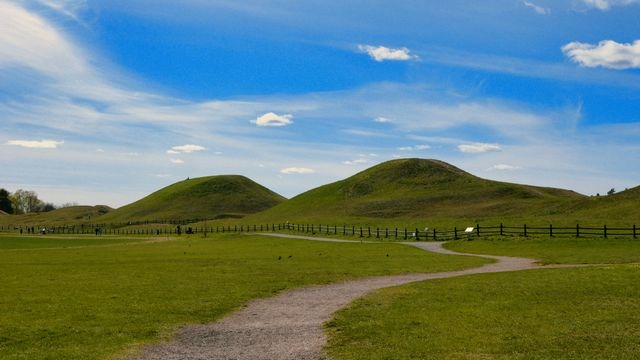
From Ireland to Louisiana, from England to Illinois, people have been piling up the earth in sacred shapes for five thousand years. The impulse never really stopped.
Here is something contemplating: every major ancient culture on earth, working independently, with no knowledge of each other, came to the same conclusion. They picked up dirt. They piled it up. They shaped it with care and intention, oriented it to the sun or the moon or the stars, and they climbed it, buried their dead beneath it, gathered around it for ceremony. From the river valleys of Ireland to the bayous of Louisiana to the great plains of Illinois, the mound is one of humanity's oldest and most persistent ideas.
Nobody told them to do this. They just did it, over and over, across every ocean and continent, across thousands of years. There's something in that pattern worth paying attention to.
Newgrange, Ireland: A Door Left Open for the Sun
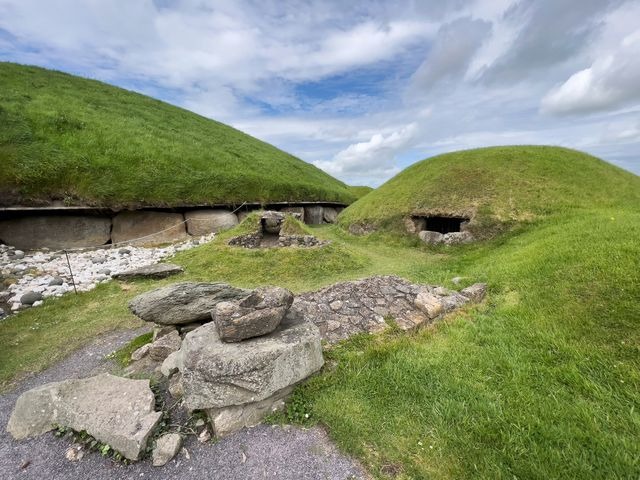
Five thousand years ago — five hundred years before the Great Pyramid was built, a thousand years before Stonehenge — people in the Boyne Valley of Ireland constructed a mound so precisely aligned that once a year, at dawn on the winter solstice, a single shaft of light travels 60 feet down a narrow stone passage and fills the inner chamber with gold.
For exactly 17 minutes. Then it's gone for another year.
The chamber is dark and low-ceilinged and smells of ancient stone, and when that light comes in on the shortest morning of the year, it must have felt — still feels — like proof of something. That the sun, which had been retreating for months, had turned around. That the world was going to keep going. That the people who built this place understood something deep about time and had carved that understanding into the earth itself.
Nobody knows what they called themselves. Their name for this place is lost. What remains is the mound, the passage, and that annual appointment with the light that they kept and that we can still keep now. Every September, Ireland holds a lottery for the sixty spots inside the chamber on the three mornings around the solstice. Tens of thousands of people enter it. If you don't win, you can still gather outside with everyone else as the sun comes up, which is its own kind of ceremony — strangers standing together in the cold Irish dark, waiting for the same thing those people waited for five millennia ago.
Silbury Hill, England: The Mound With No Answer
About 25 miles north of Stonehenge, in the green Wiltshire countryside, there is a perfectly conical hill rising 130 feet from the flat valley floor. It is the largest human-made mound in Europe. It was built around 2400 BC, took generations to complete, contains roughly the same volume of earth as the Great Pyramid, and has been excavated multiple times over the past several centuries.
Nobody has ever found anything inside it.
No burial. No artifact. No inscription, no chamber, no obvious answer at all. Silbury Hill was built — at enormous cost in labor and time — for a reason that nobody has been able to work out since. Various theories come and go. It may have been a ceremonial platform. It may have represented the primordial mound of creation that appears in the mythology of cultures the world over. It may have been all of those things and more, its meaning layered over generations the way the mound itself was layered, each generation adding earth and intention to what came before.
It sits in a valley with Avebury's stone circles and dozens of ancient barrows. The whole landscape around it is a kind of outdoor cathedral, and Silbury is its altar — or its mystery, which might be the same thing. Stand at its base and look up at the clean geometric shape of it against the sky. Something very intentional is happening here. You just don't get to know exactly what.
That turns out to be enough.
Cahokia, Illinois: The City the Continent Forgot
A thousand years ago, the largest city north of Mexico sat on the banks of the Mississippi River, just east of where St. Louis stands today. At its peak, around 1100 AD, Cahokia held perhaps 20,000 people — larger than London at the same moment in history. And at its center rose a platform mound so vast that its footprint is roughly equal to the base of the Great Pyramid of Giza.
Monks Mound, as it's called now, rises in four terraces to a height of 100 feet. The great chief lived on top. Below, a wooden palisade enclosed a plaza where ceremonies were held. Beyond that, the city sprawled across six square miles, hundreds of smaller mounds marking neighborhoods, plazas, mortuary sites. The whole complex was laid out with a precision that still impresses engineers today.
And then, sometime around 1350 AD, Cahokia was abandoned. The people scattered. The mounds stayed. The forest slowly crept back across the plazas and the neighborhoods, and by the time European settlers arrived, no one knew this city had ever existed.
Walking up Monks Mound today — the path switchbacks up through grass, the Mississippi valley spreading out below you — it's impossible not to feel the weight of what was here. At the top, the wind is strong and the view is long, and you can look out across the flat midwestern landscape and try to imagine a city filling all of it. The mound endured. The city's story is still being recovered, still being told. Come before the crowds find it properly.
Poverty Point, Louisiana: Built by People Who Weren't Supposed to Build This
The conventional wisdom used to be that monumental architecture required agriculture — that you needed a farming economy, a surplus of food, and a hierarchy of rulers before you could organize people to build something on this scale. Poverty Point, in the bayou country of northeastern Louisiana, demolished that theory.
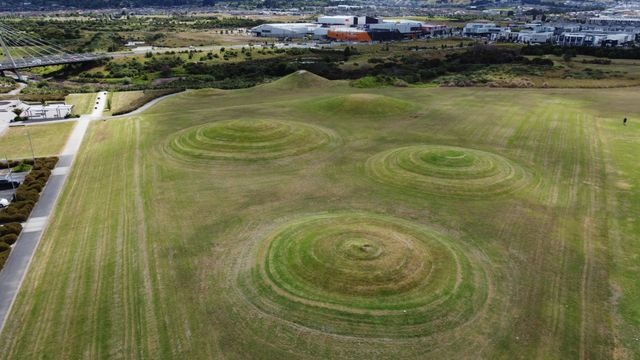
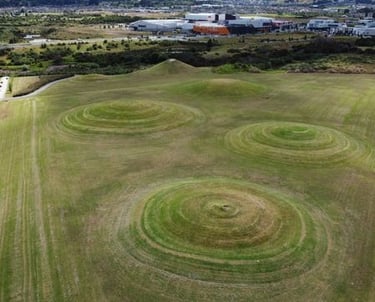
The people who built Poverty Point were hunter-gatherers. They had no agriculture, no permanent chiefs, no accumulated surplus that we can identify. And yet, sometime around 1700 BC, they constructed a complex of six concentric earthen ridges — like the rings of a half-eaten apple, open toward the river — plus several large ceremonial mounds, the biggest of which appears to have been shaped like a bird in flight. The entire complex covers more than 900 acres.
Recent research suggests it may have been built in a matter of months — perhaps by a vast temporary gathering of communities from across a wide region, people who came together for ceremony and trade and the shared act of building something that announced their presence on the earth. Far-flung travelers met here to exchange goods, perform rituals, and do something together that none of them could have done alone.
The mounds at Poverty Point are low and overgrown now, half-hidden in the grass, and the ridges are hard to read from the ground. But from the air, or from the viewing mound, the shape of the whole complex opens up, and you can see what they were doing — this enormous, careful, sacred arrangement of earth — and feel the same disorienting awe that runs through all of these places. How did they know to do this? Where did this urge come from?
The Thing All the Mounds Are Saying
Stand at the base of Monks Mound, or inside the passage at Newgrange, or at the edge of Ash Cave in the Hocking Hills, and the feeling is the same everywhere: you are in the presence of something that required more people, more time, more shared intention than you can easily hold in your mind. These places weren't built by kings with whips. They were built by communities who agreed, collectively, that this mattered enough to do together.
The Hopewell people of Ohio pulled copper from Lake Superior and obsidian from Yellowstone and buried it all under their mounds — gave it back to the earth after making it into something beautiful. The builders of Newgrange hauled 200,000 tons of stone to a river bend in Ireland and oriented a doorway to a single morning's light. The people of Poverty Point shaped the ground into a giant bird without a blueprint, without metal tools, without — as far as we can tell — anyone telling them they had to.
Every one of these places is asking the same question of the people who built it: What is worth doing together? What is worth giving everything to?
They answered with the earth. With their hands. With decades of carried baskets and packed soil and careful attention to where the sun rose on a particular morning.
The mounds are still here. The question is still good.