Your Orkney Adventure
A Guide to the Wild, Strange, and Wonderful Places You'll See
You've got quite the itinerary ahead of you. Orkney packs an unbelievable amount of history into a small patch of islands, so before you go, here's the story behind each stop, plus a few of the odder, funnier, and more surprising tidbits you probably won't find on the average plaque.
South Ronaldsay and the Churchill Barriers
Tomb of the Eagles is exactly as dramatic as it sounds. This 5,000-year-old tomb sits right on the cliff edge of South Ronaldsay, and it was found completely by accident in 1958 when a farmer named Ronnie Simison was digging for stone to build fence posts. He found a dark hole, and using nothing but a cigarette lighter for light, he discovered a chamber full of human skulls. Inside, archaeologists eventually found the bones of around 300 people, along with the talons of dozens of white-tailed sea eagles, which is how the tomb got its nickname. Here's the fun part: the only way inside is by lying on a small wheeled trolley, a bit like a skateboard, and pulling yourself through the entrance tunnel with a rope. Ronnie's family still runs the site today, and they'll happily let you handle real 5,000-year-old artifacts with your own hands.
The Italian Chapel has one of the most touching stories in all of Orkney. During World War II, 550 Italian prisoners of war were brought to Orkney to help build the Churchill Barriers, the causeways that protect the naval base at Scapa Flow. Living in a bleak POW camp, the men asked for a place to worship. What they built out of two leftover metal Nissen huts, scrap wood, and even corned beef tins is stunning: a small chapel with painted walls that look like marble and stonework, all created by a gifted prisoner named Domenico Chiocchetti. When the war ended and the men were sent home, Chiocchetti stayed behind those last few weeks just to finish the artwork. Decades later, he returned to Orkney to help restore it, and his family still visits today.
East Mainland: The Gloup and Brough of Deerness
The Gloup is a giant collapsed sea cave, and it is genuinely startling to come across. Imagine a cave whose roof caved in, leaving a deep, water-filled chasm connected to the sea by a tunnel you can still hear the waves crashing through. Its name comes from the Old Norse word for "chasm." Here's the dark bit of trivia: locals in the 1800s and early 1900s reportedly used the Gloup as a way to get rid of old farm horses that could no longer work, leading them right over the edge. Today it's a peaceful (if slightly eerie) stop on a beautiful clifftop walk.
Brough of Deerness is a sea stack that used to be connected to the mainland until the land bridge collapsed centuries ago, isolating it high above the water. Despite how hard it is to reach, Norse settlers built a chapel and around 30 buildings up there. Excavations found a coin from the 900s underneath the chapel floor, making it one of the earliest known signs of Viking Christianity in the whole North Atlantic region. People still leave coins in the chapel today as a kind of tradition, even though nobody's entirely sure why the original coins were left in the first place.
Kirkwall: Palaces, Cathedrals, and a Hidden Underground Room
Grain Earth House is one of Orkney's odder little secrets, mostly because of where it's hiding: right in the middle of a modern industrial estate outside Kirkwall. It's an Iron Age "souterrain," an underground storage chamber built around 400 BC, with a curving five-meter passage leading down to a chamber held up by ancient stone pillars. Before you can even get inside, you have to walk into town and collect a key and a torch from a gift shop, which feels a little bit like a scavenger hunt for something that's nearly 2,500 years old.
Earl's Palace was the pet project of a man named Patrick Stewart, widely considered one of the most tyrannical noblemen in Scottish history. He forced local people to build his lavish Renaissance palace, and to get the land he needed, he made up theft charges against the previous owner and had him executed. It didn't end well for Patrick either. He was eventually arrested for his own crimes, and while he sat in prison, his son led a rebellion in his name. Both were executed for treason in 1615. As one darkly funny detail, Patrick was reportedly so uneducated that his execution had to be delayed just so he could be taught the Lord's Prayer beforehand.
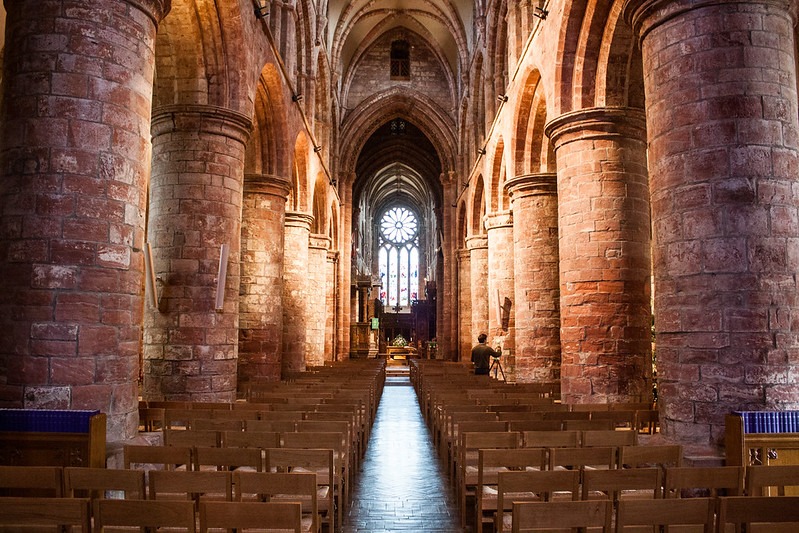
St Magnus Cathedral is the heart of Kirkwall, founded in 1137 in honor of Magnus, an Earl of Orkney who was murdered by his own cousin. Miracles were said to occur at his grave, which prompted his nephew to build this stunning red sandstone cathedral in his memory. Both Magnus and the nephew who built the cathedral are believed to be buried somewhere within its very walls, their bones hidden inside the pillars themselves.
The Heart of Neolithic Orkney
This cluster of sites, all within walking distance of each other, is where Orkney's ancient history really comes alive.
Wideford Hill Cairn and Cuween Hill Chambered Cairn sit on facing hillsides a few miles apart, and archaeologists believe this was intentional, like the two tombs were designed to gaze at each other across the valley. Cuween is famous for an odd discovery: alongside human remains, excavators found the skulls of 24 small dogs neatly placed in the burial chamber. The leading theory is that dogs were some kind of tribal symbol for the people who built it, similar to how sea eagles turned up at the Tomb of the Eagles.
Unstan Chambered Cairn gave its name to an entire category of ancient pottery, called "Unstan Ware," after archaeologists found dozens of matching bowls smashed and scattered across its floor. To get inside, you have to duck-walk through a very low, narrow passage, which makes the payoff of standing up in the burial chamber feel oddly triumphant.
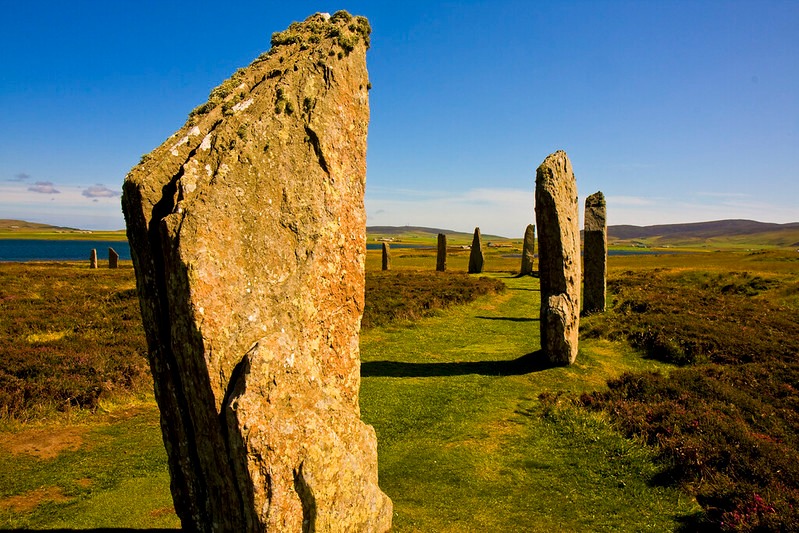
The Ring of Brodgar is one of the oldest and largest stone circles in Britain, and it's had a rough few centuries. Of the original 60 stones, only 36 survive today, and one of them was split clean in half by a lightning strike during a storm in 1980.
The Standing Stones of Stenness stand nearby, and just beyond them once stood the famous "Odin Stone," a tall stone with a hole through it. For generations, Orcadian couples would seal engagements by holding hands through that hole and swearing an oath to Odin. In 1814, a fed-up tenant farmer, tired of plowing around it, blew it up with gunpowder. The public outrage was immediate and enormous, but the stone was gone for good.
Barnhouse Settlement, tucked right next to the Standing Stones, is a group of Neolithic house foundations where the people who built these monuments likely lived, ate, and gathered.
Maeshowe might be the most famous chambered tomb in the whole of Europe, partly because of what happened to it centuries after it was built. In the 1100s, a group of Vikings broke into the tomb to shelter from a snowstorm, and while stuck inside, they carved graffiti into the walls, over 30 runic inscriptions in total. Some are boastful ("carved by the man most skilled in runes in the western ocean"), some are romantic ("Ingigerth is the most beautiful of all women"), and some are just goofy, essentially a thousand-year-old version of "so-and-so was here."
The West Coast: Cliffs, Ruins, and a Buried Village
Broch of Borwick is a smaller, crumbling Iron Age tower perched right on an eroding cliff edge near Yesnaby. It's a strange design choice when you think about it: if it was meant to be defensive, why build it with your back to the sea and nowhere to retreat? Nobody has a great answer, but the dramatic, wind-battered setting makes it worth the walk regardless.
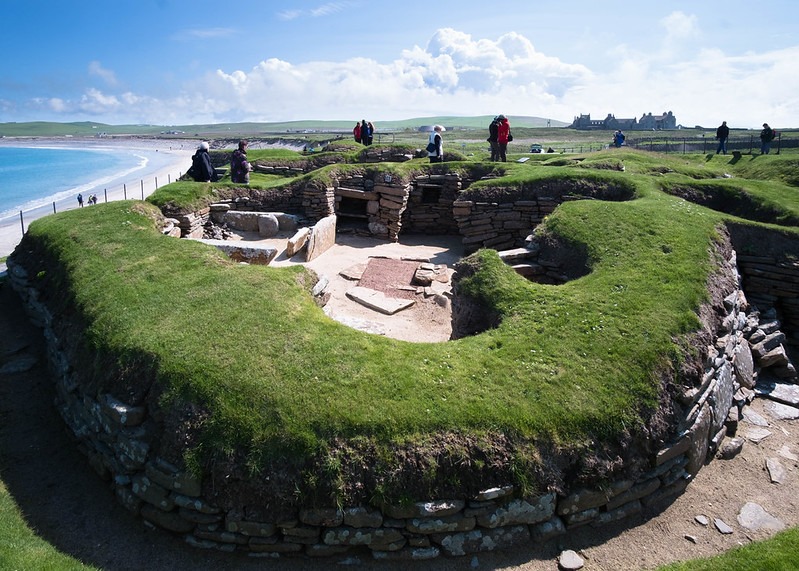
Skara Brae is Orkney's most famous site, a Stone Age village so well preserved you can still see stone beds, shelves, and even a kind of stone dresser sitting exactly where the original owners left them. It was hidden under sand for thousands of years until a massive storm in 1850 ripped away the covering dunes, revealing walls that nobody knew were there. The local laird who found it, William Watt, lived just 200 meters away at Skaill House, which you can still visit today.
The Bay of Skaill, right next to Skara Brae, is the beach where that famous storm did its work, and where more artifacts have occasionally washed out of the dunes during storms ever since.
Birsay and Marwick: Coastline and a War Memorial
The Orkney Fishermen's Huts, found tucked above Sand Geo near Birsay, are humble little stone buildings, over a hundred years old, once used to store boats and gear for generations of local fishermen working this wild stretch of coast.
Marwick Head combines two very different kinds of impact: it's a spectacular nature reserve packed with nesting seabirds, and it's also home to the Kitchener Memorial, a tall stone tower built in memory of Lord Kitchener and over 700 men who died when their ship, HMS Hampshire, struck a German mine just offshore in 1916. It's a striking place: cliffs full of birdsong and life, right next to a solemn monument to sudden loss at sea.
Broch of Gurness
This is one of the best-preserved Iron Age broch villages anywhere in Scotland, with the remains of small stone houses clustered protectively around a central tower. Long after the broch itself fell out of use, Vikings arrived and used the site for burials. One of the most interesting finds was the grave of a Viking woman, buried with an iron necklace and a pair of decorative brooches, suggesting she held some importance in her community.
Rousay: The "Egypt of the North"
The small island of Rousay has such a dense concentration of ancient tombs that it's earned the nickname "Egypt of the North."
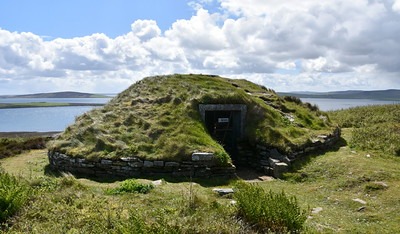
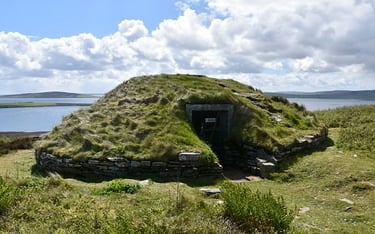
Taversoe Tuick is one of only two known "double-decker" tombs in all of Orkney, with two separate burial chambers stacked directly on top of each other, each with its own entrance. It was rediscovered in 1898 purely by accident, when a local laird was having a garden seat built for his wife and the ground gave way beneath the workers.
Blackhammer Chambered Cairn and Knowe of Yarso both belong to a cluster of stalled tombs along the same stretch of road. At Knowe of Yarso, excavators found the remains of at least 29 people, with 17 skulls carefully lined up side by side, plus the bones of 36 red deer, again hinting that this community may have used deer as a kind of tribal emblem.
Midhowe Chambered Cairn, nicknamed "the Great Ship of Death" for its massive size, stretches over 32 meters long and is now protected under a huge modern hangar that lets you walk above it on a raised platform and look straight down into its 12 burial compartments. Right next door sits Midhowe Broch, a well-preserved Iron Age tower with its own hearth, sleeping areas, and even a hidden well beneath the floor, proof that people were living here roughly 3,500 years after the cairn beside it was first built.
The Scenery and Wildlife You'll See Along the Way
Beyond the ruins and tombs, Orkney's landscape is a huge part of the experience. Towering sea cliffs, wide-open moorland, and endless stretches of coastline mean you're rarely more than a few minutes from something wild. Keep your eyes on the water and the cliffs, because Orkney is one of the best places in Britain to spot marine wildlife.
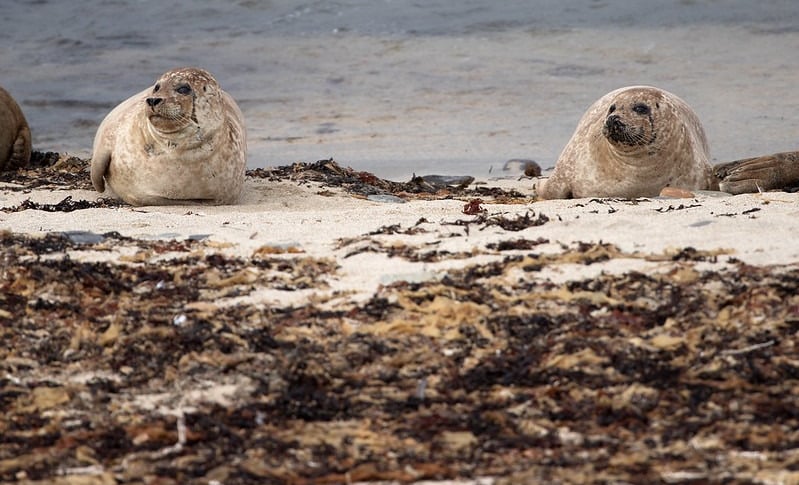
Seals haul out along nearly every shoreline, and with some luck and patience, you might catch a glimpse of orcas, dolphins, porpoises, or even minke whales moving through the sounds between islands. Up on the cliffs, especially at spots like Marwick Head and the Brough of Birsay, you'll find enormous seabird colonies packed with puffins, razorbills, kittiwakes, and gannets, especially in late spring and early summer. Don't be surprised if a short-eared owl or a hen harrier drifts silently over a field beside you, either; Orkney's lack of foxes has made it a haven for birds of prey.
A Quick Note on Clava Cairns and Culloden
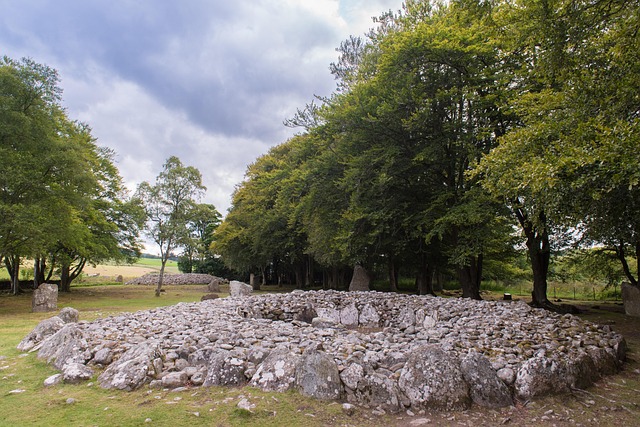
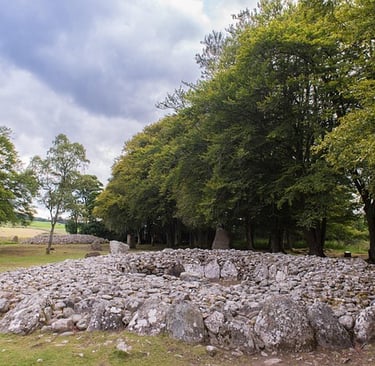
These last two aren't actually in Orkney; they're near Inverness, on the Scottish mainland. We will stop on your way to or from the ferry. Clava Cairns is a beautifully preserved Bronze Age burial site, around 4,000 years old, with three large stone cairns lined up in a row and surrounded by standing stones. If you are a fan of the series, Outlander, you know this site.
Just up the road sits Culloden Battlefield, the site of the last pitched battle ever fought on British soil, where in under an hour in 1746, around 1,500 Jacobite soldiers were killed or wounded, bringing an end to the Jacobite uprisings and the Highland culture for good. It's a sobering, quiet place, and a striking contrast to the ancient stillness of Clava Cairns just down the road.
Final Thoughts
You've got an incredible mix ahead of you: sea stacks and storm-uncovered villages, tombs shared with dogs and eagles, a chapel built from scraps and hope, and cliffs crowded with puffins and orcas offshore. Bring good boots, expect the weather to change its mind a few times a day, and take your time. Orkney rewards slow travel more than almost anywhere else in Scotland.